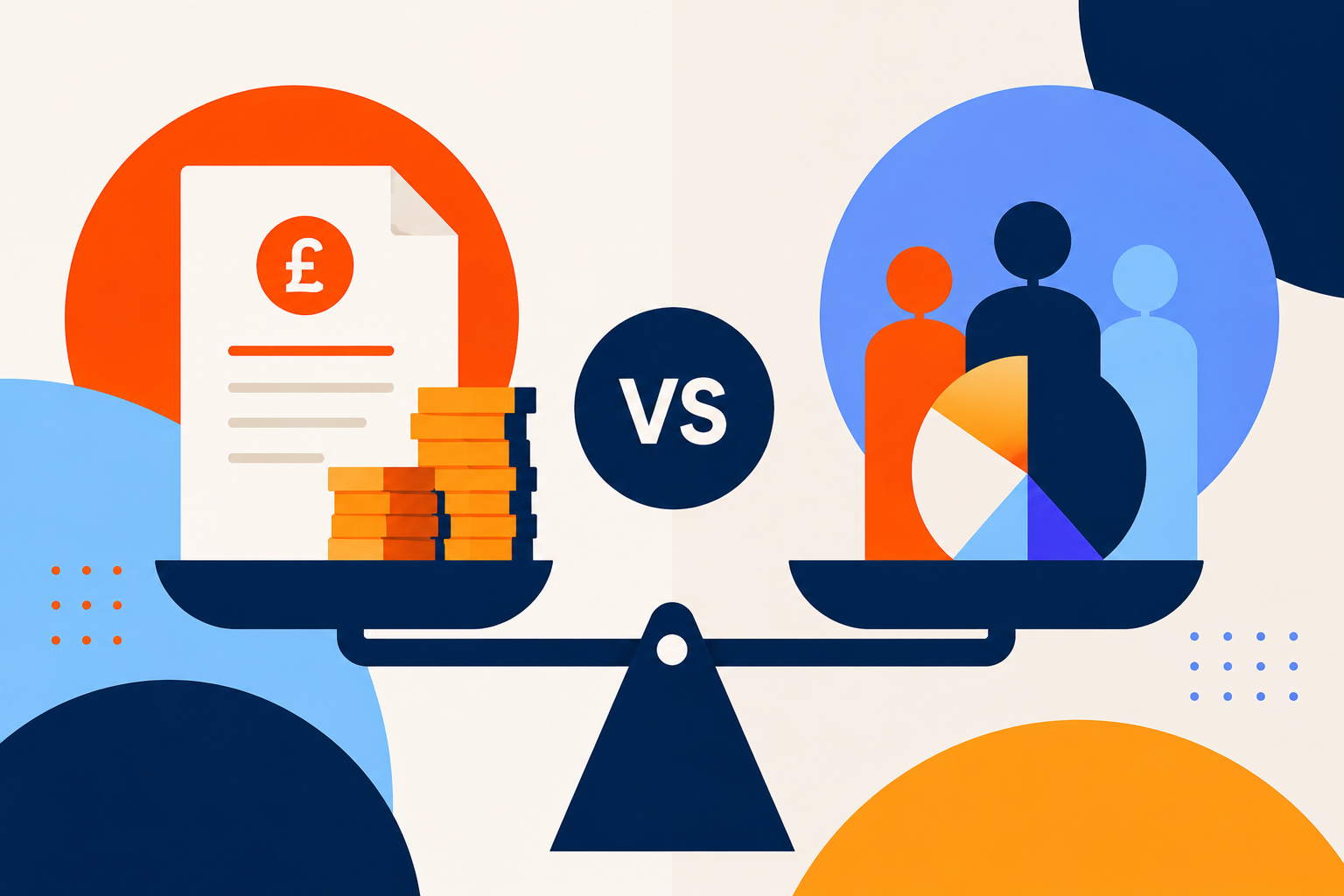
Key takeaways
- Deciding between debt financing vs equity financing comes down to your business and personal circumstances. Your growth stage, structure, and personal preferences all matter.
- Debt financing allows you to raise capital without giving up a stake in your business, but it comes with repayment obligations.
- Equity financing protects your working capital, but means you reduce your share of the business – and any future returns from its growth.
- For many established SMEs that are profitable, debt financing can be a more cost-effective and less disruptive way to grow.
What is debt financing?
Debt financing is when a business borrows money and agrees to repay it over time, usually with interest.
Common forms of debt financing include business loans, asset finance, commercial mortgages, overdrafts, and revolving credit facilities.* Visit any of those pages to get a better understanding of the different loans we offer.
For established businesses, debt financing is often an attractive option because it brings capital into the business without the owners diluting their stake in the company.
What is equity financing?
Equity financing raises funds for the business by selling some of its shares or ownership rights to investors.
Common sources of equity funding include angel investors, venture capital firms, and private equity investors. The investors put money into the business in exchange for some of its shares. They buy a seat at the table – contributing to how the business is run and benefiting from any future growth in the value of the company’s shares.
Unlike debt financing, equity funding does not need to be repaid. Investors will hope to make a return, but it’s not guaranteed. Still, equity funding means sharing ownership, future profits, and often strategic decision-making with outside investors.
Debt financing vs equity financing: key differences
For an early-stage business – with limited revenue and spiky cashflow – equity financing can be an essential part of future planning. Plus, debt finance can be inaccessible without proof of affordability. For example, Allica typically lends to businesses that have at least two years of trading history.
For established businesses, however, the decision is often more complex because the value of the business is already proven.
| Factor | Debt financing | Equity financing |
|---|---|---|
| Ownership | Shareholding is unaffected | Owners dilute shareholding |
| Repayments | Regular repayments required | No repayments required |
| Cost | Interest payments | Dilution of future value and profits |
| Control | Existing owners retain control | Investors often gain influence |
| Risk | Debts need to be paid, regardless of performance | Reduced ownership and decision-making power |
| Speed | Often faster to arrange | Can involve lengthy negotiations and due diligence |
Debt and equity work together, it’s not an either/or choice. Lots of businesses use a blend of both over time, often monitoring metrics such as their debt-to-equity ratio (more detail on that in the linked blog post) to maintain a healthy balance.
Pros and cons of debt financing
One major benefit is retaining ownership. Take one Allica Bank customer – this manufacturer arranged a £1.9m remortgage of its premises to fund international expansion, the owners will benefit from any future increase in profits and company value.
Debt can also be more predictable. Fixed repayment schedules make planning easier and allow business owners to understand exactly what their borrowing will cost over time. Loan repayments slot simply into a business’ existing cashflow planning.
Interest payments may also be tax-deductible, reducing the effective cost of borrowing for profitable businesses. HMRC’s Business Income Manual explains the specifics of tax-deductible interest.
However, debt financing is not without drawbacks. Repayments must be made on time – even if you’ve had a bad month for sales. Lenders will also assess affordability and creditworthiness, which means weaker businesses may find it harder to access funding.
Lenders will often ask for security over assets or a guarantee from the business owners. If the business can’t repay the loan, the lender may take ownership of the secured asset or seek repayment from the guarantor(s) personally.
Pros and cons of equity financing
The biggest advantage of equity financing is that there are no loan repayments. Money comes into the business without adding any debt to the balance sheet. This can be particularly helpful for businesses that are investing heavily in growth, but have yet to reach stable profitability.
Investors can also bring expertise, industry contacts, and strategic guidance alongside their capital. The right investor can unlock doors and start conversations that would otherwise be out of reach.
The disadvantages become more significant for established businesses. Selling equity means giving up a share of future profits and growth in the value of the business. Investors may also expect involvement in decision-making and influence over the direction of the company.
Raising equity can be a long process, involving negotiations, valuations, due diligence, and legal work. If you’ve poured years of work, effort, and money into growing your business, it can feel difficult to give up some of your stake in the company.
Debt vs equity financing: real-world examples
Imagine a manufacturing business that has won several new contracts. The company has strong cashflow, a proven track record, and clear growth opportunities. They want to expand their capacity to meet and sustain the increased demand. In this case, the company’s current and future performance supports a business loan and the owners can fund expansion without diluting their shareholding.
On the other hand, you can look at Allica for an example of equity financing. In H1 of 2026, we announced our Series D fundraise. This was an opportunity to bring more capital into the business, while also bringing in a new suite of investors with valuable strategic input. We’re investing the funding into proprietary technology and AI adoption that will grow the business long-term, but won’t deliver an immediate return that could justify debt finance.
There’s not a universal answer in the debt vs. equity financing debate. The right option depends on where you are, where you’re going, and what you need to happen.
Which is cheaper — debt or equity financing?
Access to finance is important, of course, but affordability is the next hurdle to overcome. The costs associated with debt and equity financing are quite different, which makes them awkward to compare.
Debt financing has a clear cost in the form of interest payments. Equity financing can appear cheaper because there are no repayments, but the long-term cost can be much higher.
Imagine a business owner sells 20% of their company to raise £500,000. If the business later doubles in value, that 20% stake could be worth £1 million. In that scenario, the cost of equity may far exceed the interest that would have been paid on a loan.
It’s nearly impossible to calculate a fair comparison, because equity funding is – in a way – a bet on your future growth. Not all bets come off, even the ones with good odds. That £500,000 stake could end up being worth £50 – but hopefully not!
Which option is right for your business?
When weighing up debt vs equity financing pros and cons, ask yourself four questions:
- Can the business comfortably afford repayments?
- Do you want to retain full ownership and control?
- Is the business already profitable and established?
- Are you raising finance to support growth, or to prove a new business model?
If your business has stable revenue, predictable cashflow, and a proven track record, debt financing will often be the more straightforward option.
If your business is early-stage, highly speculative, or unable to support repayments, equity may be more appropriate.
Of course, these are generalised statements. Your situation is unique and will require bespoke, expert advice.
When does equity financing make sense?
Equity financing is not inherently good or bad. It’s one option in your fundraising toolbox.
For businesses with little trading history, limited cashflow, or high levels of uncertainty, equity can provide access to capital that traditional bank lending may not.
It can also make sense where investor expertise is as valuable as the funding itself. Some investors bring industry knowledge, networks, and strategic guidance that create the opportunities you need to grow.
However, for many established SMEs with proven revenue and profitability, the attraction of debt financing is that it offers access to capital without the trade-off of selling equity.
How Allica Bank can help you finance your next stage of growth
If you're an established business looking to invest, expand, or acquire property, we could be the lender for you.
We specialise in supporting established businesses with loans, commercial mortgages, asset finance, growth finance, and more.* That’s alongside our current account and business tools – together, they make up true full-service banking for established businesses.
We combine old-school relationship-led banking with modern technology. So, we can move fast while delivering a brilliant and personalised service.
If that sounds good, we’d love to see how we can help – let’s talk.
* All lending is subject to status, our lending criteria, and a satisfactory credit assessment. Terms and conditions apply.
Links were live and information was correct at the time of writing the article.
Disclaimer: This is information – not financial advice or recommendation
The content and materials featured in this article are for your information and education only, and are not intended to take into consideration any particular recipients’ financial situation. The product details and interest rates referred to are correct at the time of writing.
The information does not constitute financial advice or recommendation and should not be considered as such. Allica Bank will not accept any liability for any loss, including without limitation to, any loss of profit, which may arise directly or indirectly from use of or reliance on such information.